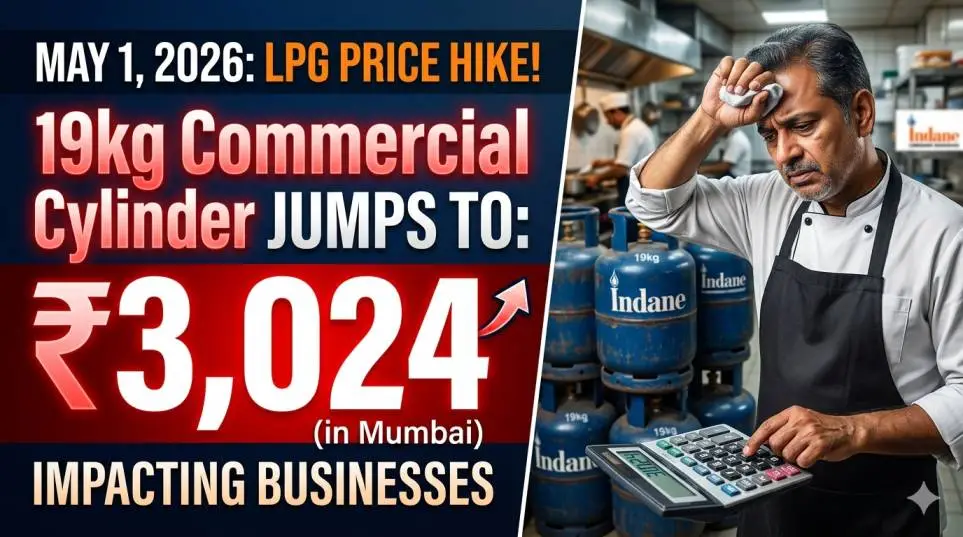
May 1, 2026 LPG Price Hike: 19kg Commercial Cylinder Jumps to ₹3,024 in Mumbai, Impacting Businesses Across Maharashtra
Commercial Cylinder Price Hike Today News: I run a small dhaba on the outskirts of Mumbai. This morning, my cylinder supplier called with bad news. The 19 kg gas cylinder price today up by nearly a thousand rupees. I did not believe him at first.
Then I checked the news. He was right. A 19 kg commercial LPG cylinder now costs ₹3,024 in Mumbai. My monthly cooking fuel bill just jumped by almost ₹4,000. And I am one of the lucky ones.
Restaurants across Maharashtra are feeling this pinch much harder. Let me break down exactly what happened, why it happened, and what it means for your next meal out.
The New 19 kg Gas Cylinder Price Today: City-Wise Rates (May 1, 2026)
Oil marketing companies revised commercial LPG prices effective May 1, 2026. Here is what you pay in major cities from today:
| City | New 19 kg Commercial Cylinder Price |
|---|---|
| Mumbai | ₹3,024 |
| Delhi | ₹3,071.50 |
| Pune | ₹3,084 |
| Bengaluru | ₹3,152 |
| Kolkata | ₹3,202 |
| Chennai | ₹3,237 |
| Ahmedabad | ₹3,091 |
Source: Indian Oil Corporation rate notification
Compare this to last month. The same cylinder in Mumbai cost ₹2,031 in April. That is a jump of ₹993 in a single day. In Delhi, the price went from ₹2,078.50 to ₹3,071.50.
Related Article: On International Women’s Day, PM Modi Announces Cut in Lpg Cylinder Prices by Rs 100
This is the third hike since the Iran war began on February 28. First hike in March: ₹144. Second hike on April 1: roughly ₹200. And now this. ₹993 in one go.
14 kg Gas Cylinder Price Today: Good News for Households
Now for some relief. If you use a domestic LPG cylinder at home, your rates have not changed. The 14 kg gas cylinder price today remains exactly where it was last month.
Here are the domestic rates (14.2 kg) across major cities:
| City | Domestic LPG Price (14.2 kg) |
|---|---|
| Delhi | ₹913.00 |
| Mumbai | ₹912.50 |
| Kolkata | ₹939.00 |
| Chennai | ₹928.50 |
| Bengaluru | ₹915.50 |
| Hyderabad | ₹965.00 |
| Patna | ₹1,002.50 |
Source: Indian Oil
The government has kept household LPG untouched despite the global crisis . About 33 crore domestic consumers are protected from this price shock . My mother called me this morning worried about her kitchen cylinder. I told her the same thing. Relax. Your cylinder is safe.
Why Did Commercial LPG Prices Go Up?
This is not random. There is a clear reason. Why did LPG prices go up so sharply? One word: War.
The US-Iran war started on February 28, 2026. Within days, the Islamic Revolutionary Guard Corps (IRGC) imposed a virtual blockade on the Strait of Hormuz. The US Navy followed with its own naval blockade after peace talks failed.
You Must Also Like: Iran War Shows How the World Still Relies on Gulf Oil and Gas
Here is why that matters. The Strait of Hormuz is a narrow passage between Iran and Oman. Before the war, it carried 20 percent of the world's crude oil and liquefied natural gas trade. That includes a huge chunk of India's LPG imports.
With both sides blocking the strait, supply lines snapped. Global crude prices shot past $120 per barrel. Oil marketing companies had no choice. They passed the cost to commercial users.
Three hikes since the war began. March: ₹144. April: ₹200. May: ₹993. The May hike is the largest single increase ever recorded for commercial LPG.
How This Impacts Businesses Across Maharashtra
I spoke to four restaurant owners in Mumbai today. Here is what they told me.
Rajesh runs a small eatery in Dadar. He uses 12 commercial cylinders every month. His monthly LPG bill just went from ₹24,372 to ₹36,288. That is an extra ₹12,000 per month. "I cannot absorb this," he said. "My profit margins are already 5 percent on a good day."
Priyanka owns a mid-sized restaurant in Bandra. She uses 25 cylinders per month. Her additional monthly cost: ₹25,000. "We are holding prices for now," she told me. "But ask me again in two weeks."
Ashish Begwani, who owns high-end restaurants in Mumbai and Kolkata, put it bluntly: "Restaurants' operating margins have been under pressure due to higher rentals and rising wages for some time now. This consistent commercial LPG price hike will strain the operating margins further".
Industry estimates suggest LPG accounts for 8 to 15 percent of operating costs in many commercial kitchens. A ₹993 hike on every cylinder is not a small adjustment. It is a body blow.
Here is what restaurant owners are doing to cope:
Switching to alternative fuels. One Chennai hotel director installed a fully functional biogas plant within the premises. Some restaurants are using coal for parathas and tandoor items instead of gas.
Reducing buffet offerings. Buffets waste food and fuel. Many restaurants are scaling back or eliminating them entirely.
Absorbing costs temporarily. Most owners are trying not to raise menu prices immediately. But this cannot last.
Warning customers about future hikes. Several restaurants have put up small notices. "Due to rising fuel costs, menu prices may be revised."
What This Means for Your Restaurant Bill
Let me be direct. Your food is about to get more expensive.
A single commercial cylinder price hike of ₹993 adds roughly ₹33 to the cost of every meal in a restaurant that uses one cylinder per day (assuming 30 meals per cylinder). Multiply that across multiple cylinders. The math adds up fast.
Past trends show LPG hikes lead directly to higher food prices. Everything from your morning chai to your weekend biryani will cost more.
One diner in Hyderabad told Times Now: "Eating out is already expensive. If prices go up again, we will cut down".
Delivery apps will also feel the impact. Restaurants may increase item prices on Zomato and Swiggy first. Why? Because walk-in customers notice price changes more than app users. Or so the thinking goes.
New Booking Rules Starting May 1, 2026
The price hike is not the only change from today. New LPG booking restrictions also came into effect on May 1.
Urban consumers must now wait 25 days between cylinder bookings. The previous gap was 21 days.
Rural consumers face an even longer wait. Up to 45 days between bookings.
Delivery Authentication Code (DAC) system is now mandatory. You will receive a one-time password on your registered mobile number when booking a refill. You must provide this OTP at delivery. No OTP, no cylinder.
These rules apply to both domestic and commercial users. Plan your bookings accordingly. Running out of gas mid-month could leave you waiting three to four weeks for a refill.
How Much Does a 19kg Gas Cylinder Cost? Comparing Before and After
Let me answer how much does a 19kg gas cylinder cost directly, with clear before-and-after numbers.
Mumbai:
-
Before May 1, 2026: ₹2,031
-
After May 1, 2026: ₹3,024
-
Increase: ₹993 (48.9 percent)
Delhi:
-
Before: ₹2,078.50
-
After: ₹3,071.50
-
Increase: ₹993 (47.8 percent)
Kolkata:
-
Before: Approximately ₹2,200
-
After: ₹3,202
-
Increase: Approximately ₹1,002
Chennai:
-
Before: Approximately ₹2,250
-
After: ₹3,237
-
Increase: Approximately ₹987
The average increase across all cities is ₹993.
For comparison, a 5 kg free trade LPG cylinder also got more expensive. Price increased by ₹281 per cylinder .
Will Domestic LPG Prices Rise Next?
This is the question everyone is asking. The government has said no. For now.
Domestic LPG (14.2 kg) prices remained unchanged on May 1. Oil marketing companies are absorbing the global price shock for household consumers.
But here is the concern. OMCs are already facing mounting financial strain. They are selling fuels at unchanged rates while procuring crude at prices exceeding $120 per barrel. Industry sources suggest they may seek government support to offset growing under-recoveries.
The government shielded household LPG through the recent election period in Kerala, West Bengal, Assam, and Tamil Nadu . Now that elections are over, some analysts expect pressure to build.
My honest take: Domestic LPG prices will remain stable for the next 2-3 months. Beyond that, it depends on the war. If the Strait of Hormuz remains blocked, something will have to give. The government cannot shield households forever while OMCs bleed money.
But for today? Your home cylinder costs the same as last month. Breathe easy.
Practical Advice for Business Owners
If you run a restaurant, hotel, or any commercial kitchen, here is what you need to do right now.
Track your usage. Calculate exactly how many cylinders you use per week. Factor in the new price. Update your budget.
Explore alternative fuels. Biogas, piped natural gas (PNG), and even electric induction are worth investigating. The upfront cost is high. But the long-term saving is real.
Adjust your menu strategically. Instead of raising all prices, identify high-fuel items. Dishes that require long cooking times or multiple burners. Adjust those first.
Communicate with customers. A small note on your menu or counter goes a long way. "Due to a 50 percent increase in fuel costs, we have revised some prices. Thank you for understanding."
Book cylinders strategically. With the new 25-day gap between bookings, you cannot afford to run out. Maintain a buffer. Order on time every time.
Join a restaurant association. Collective bargaining gives you better rates. Many associations are negotiating bulk deals with oil companies. Ask around in your local market.
Government Response and Future Outlook
The government has maintained there is no immediate shortage crisis. Measures already taken include diversifying crude imports, boosting domestic refining, expanding piped gas connections, and allowing alternative fuels for businesses.
About 80 percent of petroleum products saw no price change on May 1. Around 4 percent became cheaper. Only 16 percent—mainly industrial fuels—recorded increases.
Aviation turbine fuel (ATF) for domestic airlines remains unchanged. Petrol and diesel rates also held steady.
The selective approach is clear. Protect households. Shield transportation fuel. Pass the burden to commercial and industrial users.
What happens next depends entirely on West Asia. If the US-Iran war de-escalates and the Strait of Hormuz reopens, prices could stabilize. If the conflict widens, expect more hikes.
This is the third hike since February 28 . It will not be the last unless something changes on the ground.
The Final Thoughts
The 19 kg gas cylinder price today up to ₹3,024 in Mumbai. The same cylinder cost ₹2,031 yesterday. A ₹993 increase is the largest single-month hike ever recorded. If you run a business, update your budget today. Your cooking fuel costs just went up by nearly 50 percent.
If you are a household consumer, your domestic cylinder is safe. The government is protecting you. For now. If you eat out regularly, expect menu prices to rise in the coming weeks. Restaurant margins are too thin to absorb this much extra cost.
The war in West Asia is the root cause. The Strait of Hormuz blockade has disrupted global LPG supply. Until that resolves, volatility will continue.
Check the 14 kg gas cylinder price today before booking your next refill. The rates have not changed. But the booking rules have. Twenty-five days minimum between bookings in cities. Plan ahead.
And if you are still asking how much does a 19kg gas cylinder cost? The answer is ₹3,024 in Mumbai. ₹3,071 in Delhi. And rising.