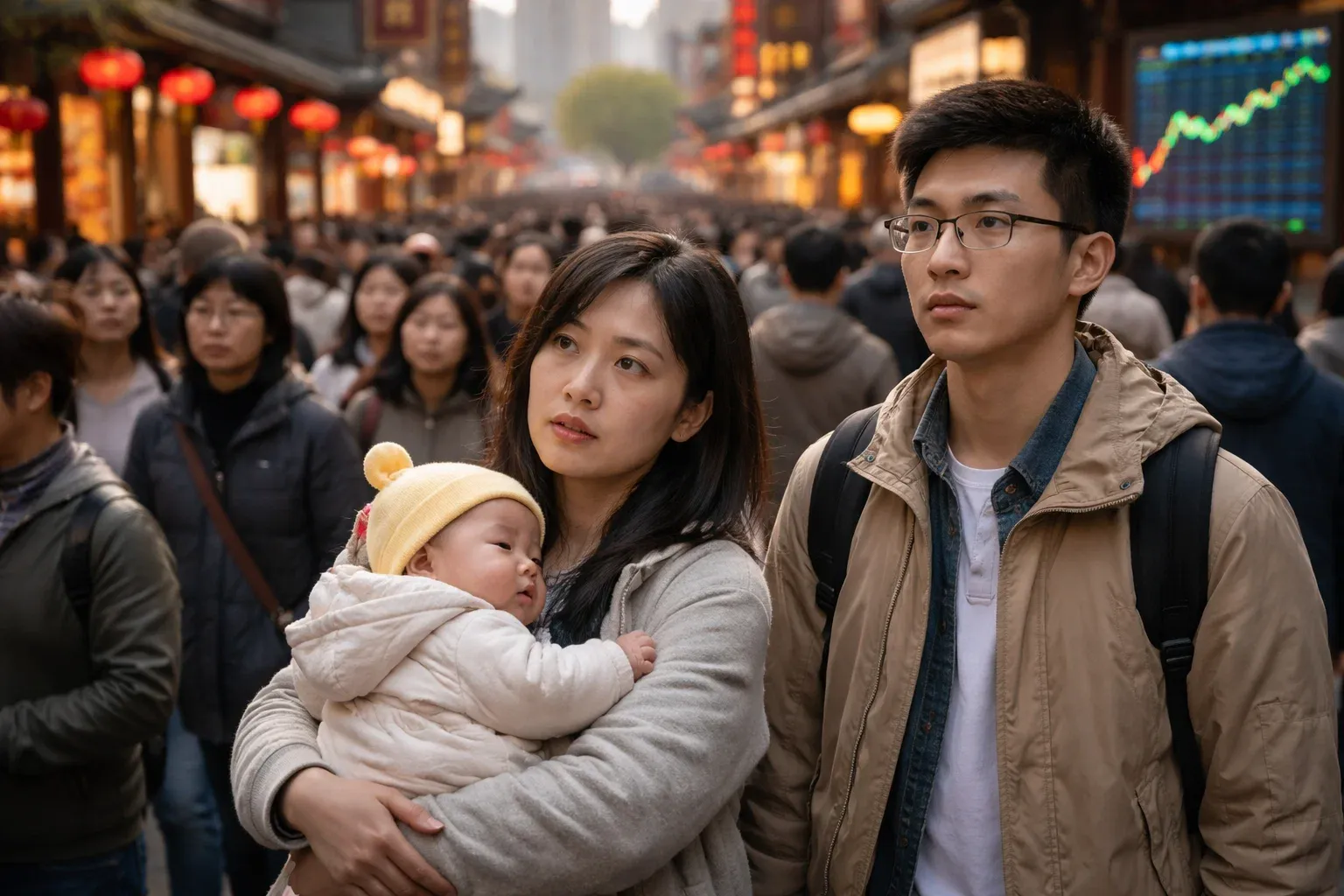
China Birth Rate Hits Record Low as Economy Hits Growth Goal
China’s birth rate has fallen to a unused record low indeed as the nation reports that it hit its official financial development target. Less babies are being born each year, the populace is maturing quick, and families are choosing to have one child or none at all.
Then, China’s economy is still extending on paper, driven by trades, state investing, and fabricating. This part — powerless births, consistent development — is presently one of the greatest stories forming China’s future.
Now let’s moderate down and conversation it through. Step by step.
What Happened to China’s Birth Rate?
It dropped. Again. China fair logged the most reduced number of births since present day records started. The China richness rate 2025 sits well underneath what specialists call “replacement level,” which is approximately 2.1 children per lady. China isn’t close. Not indeed close.
Read Also: China–India Relations: Challenges and Opportunities
The current China birth rate per lady is drifting close 1.0. A few gauges put it lower in huge cities. That implies one child for each lady, on normal. Now and then less. That’s not a plunge. That’s a cliff. And it keeps getting steeper.
How Low Is “Record Low,” Really?
Picture a chart.
A China populace chart from the 1960s shoots up like a rocket. At that point it slowthes. At that point it twists. Presently it slants down.
In crude numbers, births have fallen year after year. Passings are rising as the populace ages. The result is a contracting populace. China is no longer the world’s most crowded nation. India passed it.
That move happened unobtrusively. But it’s massive.
One-word summary?
Historic.
Why Are Less Babies Being Born in China?
This isn’t almost one thing. It’s around numerous things stacking up.
Cost
Raising a child in China is costly. Lodging. School. Additional classes. Wellbeing care. Guardians feel crushed, particularly in cities like Shanghai and Beijing.
So they wait.
- Or they halt at one.
- Or they pick out.
- Work pressure
Long hours. Tall push. Small time off. Numerous youthful grown-ups don’t see how kids fit into that life. A few don’t need to try.
Fair.
Changing views
Marriage happens afterward presently. In some cases not at all. Ladies, in specific, are pushing back against ancient parts that anticipated them to grant up careers for family.
You Must Also Like: Is the China Post News State Owned?
That move is genuine. And lasting.
Policy scars
Decades of the one-child approach changed propensities. Indeed in spite of the fact that limits are gone, the attitude stuck. When the state tells you “fewer is better” for a era, individuals listen.
Then they keep listening.
Didn’t China Attempt to Settle This?
Yes. Numerous times. First, it finished the one-child run the show. At that point it permitted two kids. At that point three. Then it advertised advantages. Cash. Charge breaks. Lodging offer assistance. Additional leave. Still no infant boom. Why?
Because arrangements can’t fix every day push. Or tall lease. Or fear approximately the future. People don’t react to trademarks. They react to life.
How Does This Interface to China’s Economy Hitting Its Development Goal?
This is where it gets interesting.
China’s economy still developed at or close its official target. Industrial facilities ran. Trades moved. Framework investing made a difference prop things up.
On paper, development looks fine.
But socioeconomics don’t care around paper.
An economy can develop this year whereas discreetly setting up inconvenience for the following twenty years.
That’s what’s happening.
Why Does a Low Birth Rate Matter for the Economy?
Because laborers don’t show up by magic. Fewer babies nowadays cruel less specialists tomorrow. That leads to:
- Labor shortages
- Slower long-term growth
- Higher costs for senior care
- Pressure on annuity systems
China built its rise on a gigantic, youthful workforce. That edge is fading.
And fast.
Quick Realities You Should to Know
Here are a few clean focuses that whole it up:
- China’s birth rate is at its least level on record
- The China richness rate 2025 is close 1 child per woman
- China’s populace is presently contracting year over year
- The economy still hit its official development target
Long-term development dangers are rising due to aging
Short. Clear. Difficult to ignore.
What Does a Contracting Populace See Like on the Ground?
Empty classrooms. Closed kindergartens. Towns with more grandparents than kids. Some schools as of now battle to fill seats. Nearby governments consolidate classes. Instructors move roles.
Meanwhile, healing centers see more elderly patients. Less maternity wards. More nursing homes.
The adjust flips.
And once it flips, it’s difficult to flip back.
Can migration illuminate China’s populace problem?
Not easily.
China has never depended on large-scale movement. Dialect obstructions. Social crevices. Approach limits. All make it tough.
Even if rules changed tomorrow, movement would as it were moderate the decay. It wouldn’t switch it.
The math is as well big.
Is This Fair a China Problem?
No. But China’s scale makes it different. Japan. South Korea. Parts of Europe. All confront low birth rates. But China’s populace is gigantic, and its financial part is global.
When China sniffles, supply chains capture a cold. So this things distant past its borders.
How Does This Influence the United States?
In calm ways. A slower-growing China implies less request for products. That hits exporters. It moreover reshapes exchange and speculation flows.
At the same time, an maturing China may spend more on wellbeing tech and administrations. That opens modern markets.
- Risk and chance. Together.
- What approximately ladies in all this?
- They’re at the center.
Many Chinese ladies say the framework inquires as well much and gives as well small back. Long work hours. Career punishments for parenthood. Constrained child care.
So they select freedom.
That choice isn’t a emergency. It’s a signal.
Ignore it, and birth rates remain low.
Personal Viewpoint: What Numbers Miss?
Here’s my take.
Birth rate charts don’t appear feeling. But choices almost kids are enthusiastic. Profoundly so. People don’t skip parenthood since of one stat.
They do it since they don’t feel secure, steady, or cheerful enough. Until that changes, no arrangement change will matter. Could mechanization fill the laborer gap?
Partly.
China contributes intensely in robots and AI. Manufacturing plants as of now utilize more machines than ever. That makes a difference productivity. But robots don’t pay charges the same way.
They don’t back maturing guardians. They don’t devour like humans. Automation is a apparatus. Not a cure.
What Happens Next?
Short term? China keeps developing, but slower. The government inclines on tech, trades, and state projects. Long term? Socioeconomics chomp. Hard. Every year with less births locks in the future. There’s no quick fix. This is a moderate story. But a effective one.
So Where Does This Take off China?
At a crossroads. Strong sufficient to meet development objectives. Delicate sufficient to stress around what comes next.
The falling birth rate isn’t a feature for one day. It’s a foundation drumbeat that will shape arrangement, markets, and lives for decades. And once you listen it, you can’t unhear it. That’s the genuine story.