India’s Great Recalibration: Why New Delhi is Easing FDI Scrutiny on China-Linked Funds
I have tracked India’s FDI policy changes since 2020. The last five years have been a nightmare for any founder with China-linked investors in their cap table. Deals stalled. Funding rounds collapsed. Lawyers made a fortune.
Then came May 1, 2026. Everything changed.
The Indian government quietly opened a narrow door. Foreign companies with up to 10 per cent Chinese or Hong Kong shareholding can now invest through the India automatic route 10 percent Chinese FDI provision. No government approval needed for most sectors.
Let me explain what this means for you. Not the press release version. The real, on-the-ground version.
First, Understand What Just Happened?
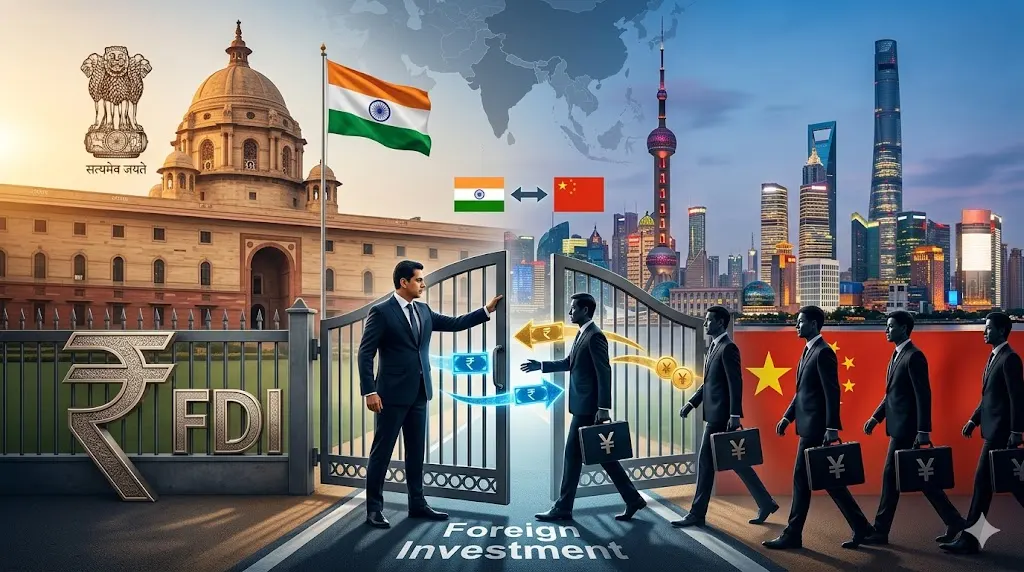
Back in April 2020, India introduced Press Note 3 after the Galwan clashes. Any investor from a country sharing a land border with India needed government approval. That meant China. Also Pakistan, Bangladesh, Nepal, Bhutan, Myanmar, and Afghanistan.
Read Also: China Birth Rate Hits Record Low as Economy Hits Growth Goal
Here is the catch. The rule caught more than direct Chinese investors. A Singapore-based fund with one Chinese limited partner holding a tiny stake also needed approval. A US venture firm with Chinese institutional money in its pool? Same problem.
The result was brutal. Between 2020 and early 2026, over 500 proposals piled up. Only 124 got approved. 201 were rejected. The rest just sat there.
Founders waited 8 to 9 months for approvals. Deals fell apart. Term sheets expired. Startups ran out of cash while lawyers argued about beneficial ownership. The government finally admitted the problem in March 2026. They amended Press Note 3. The changes went live on May 1.
The 10 Per Cent Threshold Changes Everything
Here is the core of the new policy.
Foreign companies with Chinese or Hong Kong shareholding of 10 per cent or less can now invest through the India automatic route 10 percent Chinese FDI provision. No government approval required. Just standard reporting to the authorities.
But you need to understand the fine print.
The definition of "beneficial owner" now matches the Prevention of Money Laundering Act rules . That means controlling ownership interest is defined as owning more than 10 per cent of shares, capital, or profits.
If a Chinese LP owns 8 per cent of a Mauritius fund, that fund can invest in India without approval. Passive exposure is fine. Strategic control is not.
The government also clarified something important. Multilateral banks where India is a member do not count as Chinese entities even if China contributes capital.
Where the Automatic Route Applies?
The India automatic route 10 percent Chinese FDI provision covers most sectors where FDI is already allowed without approval. That includes many technology, manufacturing, and service sectors.
You Must Also Like: Is the China Post News State Owned?
But three big exceptions exist.
First, entities incorporated in China or Hong Kong cannot use this route. A Chinese company with 100 per cent Indian shareholders still needs approval. The incorporation location matters more than the ownership.
Second, sensitive sectors like defense, space, and atomic energy remain under government route only. No exceptions here.
Third, any investment that gives the Chinese investor control or board seats requires approval regardless of the ownership percentage.
I spoke to a lawyer who handled cross-border deals. His exact words: The government is separating passive capital from active control. They want the money. They do not want the influence.
The Fast-Track Option for Manufacturing
The government also created an expedited approval process for specific manufacturing sectors. Proposals get processed within 60 days instead of 8 months.
The list covers 40 sub-sectors under six broad categories:
-
Capital goods manufacturing
-
Electronic capital goods
-
Electronic components
-
Polysilicon and ingot-wafers
-
Advanced battery components
-
Rare earth permanent magnets and processing
Specific items include camera modules, printed circuit boards, lithium-ion batteries, machine tools, and display components.
One condition applies. The Indian investee company must remain majority owned and controlled by Indian citizens at all times.
This is a significant change. Most FDI proposals from China used to take 6 to 12 months. Now critical manufacturing deals get approvals in 2 months.
Why India Is Doing This Now?
Three reasons drive this policy shift.
First, the backlog became unsustainable. Over 500 proposals piled up. Each one represented jobs, factories, and economic activity. The approval system could not keep up.
Second, India needs manufacturing investment. The electronics and semiconductor sectors cannot grow without foreign capital and technology. Chinese companies have both. The government decided controlled access beats no access.
Third, the trade deficit keeps widening. Despite five years of restrictions, India still imports billions of dollars worth of goods from China . The economic survey itself argued that having Chinese companies invest and manufacture in India creates more domestic value than just importing finished products.
A Chinese business representative in India summed it up well. This is selective opening. They need our technology for sectors they want to grow. Everything else stays closed.
What This Means for Startups?
The biggest beneficiaries will be growth-stage technology startups.
Why? Because global venture capital funds often have diversified limited partner bases. A US fund might have Chinese university endowments or pension funds as LPs. Those LPs own small percentages. They have no control over investment decisions.
Before the change, that US fund needed approval to invest in India. Now they use the India automatic route 10 percent Chinese FDI provision.
Lawyers expect deal velocity to increase by 20 to 30 per cent . Faster closings. Less regulatory uncertainty. Better terms for founders.
Sectors likely to see immediate impact include:
-
Software-as-a-service
-
Fintech
-
Deep-tech
-
Electronics manufacturing
-
Electric vehicle ecosystem
-
Late-stage consumer internet
What This Does NOT Mean?
Let me be clear. This is not a full reopening to Chinese capital.
Direct investments from Chinese companies still need approval. A Chinese auto parts manufacturer wanting to build a factory in India cannot use the automatic route. They wait in line with everyone else.
Hong Kong-incorporated entities also get no special treatment. Many Chinese outbound investments used Hong Kong holding companies. Those structures still face full scrutiny.
And the 10 per cent threshold is strict. Go over it even by accident, and you need approval. The government will check.
A think tank analysis noted that China's direct share in India's cumulative FDI remains just 0.3 per cent, or about $2.51 billion. This policy does not change that number dramatically.
Practical Advice for Founders and Investors
Here is what I would do if I were raising money or investing right now.
Map your cap table carefully. List every shareholder above 1 per cent. Identify their citizenship and incorporation location. Check if any Chinese or Hong Kong entities appear.
Keep Chinese ownership under 10 per cent. The threshold is strict. Do not approach 9.9 per cent and assume safety. Leave margin for error.
Avoid governance rights. No board seats. No veto powers. No special approval rights for Chinese investors. The government watches for control, not just ownership.
Use non-LBC investment vehicles. A fund based in Singapore, Mauritius, or the US works better than one based in Hong Kong or China. The incorporation location triggers different rules.
File proper reporting. The Indian investee company must report to DPIIT before receiving funds . Missing this step creates compliance problems later.
Who Benefits Most?
Global funds with diversified LPs gain the most. They can now deploy capital faster without restructuring their fund vehicles.
Indian founders with existing China-linked investors also benefit. Follow-on rounds become easier. New investors do not fear getting caught in approval backlogs.
Manufacturing startups in the 40 specified sub-sectors get the best deal. Not only can they receive China-linked capital through the automatic route, but direct Chinese investments in their sector also get 60-day approvals.
Who Still Faces Hurdles?
Large direct investments from Chinese companies still require approval. Nothing changed here.
Hong Kong-incorporated funds cannot use the automatic route even with small Chinese ownership.
Sensitive sectors like defense and space remain completely closed to China-linked capital.
Any deal giving Chinese investors control still needs government sign-off.
The Final Thoughts
The India automatic route 10 percent Chinese FDI policy is a calibrated opening. Not a floodgate. Not a reversal of 2020 restrictions.
The government wants passive capital without strategic control. They want Chinese manufacturing investment without Chinese ownership of sensitive sectors. They want technology transfer without political influence.
For founders and investors who understand these boundaries, the new rules create real opportunities. Faster deals. Less uncertainty. More capital available.
For everyone else, the approval queue still exists. Just slightly shorter than before.
Check your cap table. Know your beneficial owners. Stay under 10 per cent. Follow the reporting rules.
The door is open a crack. That is enough for now.