World Environment Day 2026: Indian Firms Go Circular
I visited a material recovery facility in Mumbai last year. The noise was loud. The smell was worse. But what struck me was the speed of the women sorting waste. They touched a plastic bottle. They knew its type in half a second. PET. HDPE. Soft plastic.
That is expertise you cannot teach in a classroom. On World Environment Day 2026, that image keeps coming back to me. Because the World Environment Day theme 2026 is "Inspired by Nature. For Climate. For Our Future." And Indian companies are finally realizing that waste is not garbage. It is a design flaw.
So, What Is the World Environment Day Theme 2026 Exactly?
Let me clear up the confusion first. Different sources report slightly different phrasing. Here is the truth.
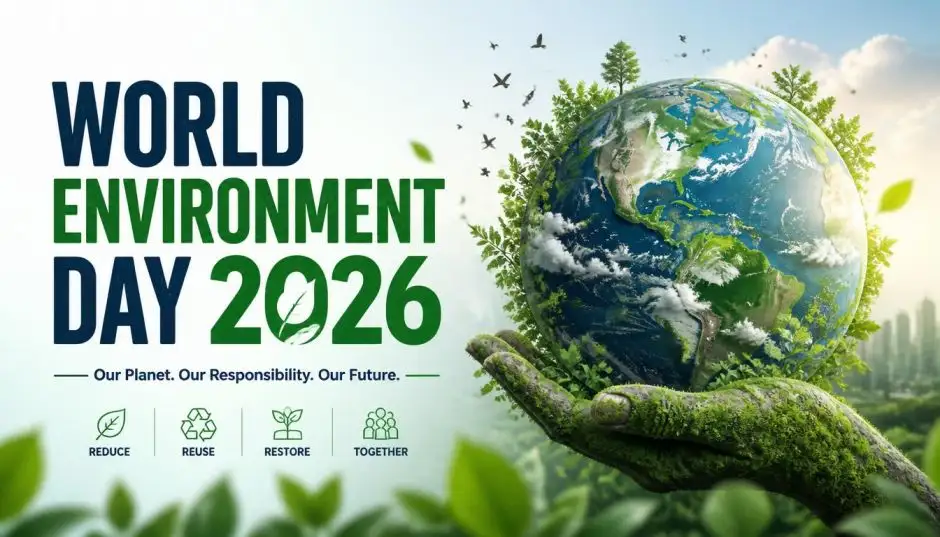
The United Nations Environment Programme (UNEP) runs the global campaign. The official World Environment Day theme 2026 focuses on climate action. The campaign message is "Now For Climate."
Read Also: London Tube Strikes June 2026: Is the Elizabeth Line and Overground Affected?
But Azerbaijan, the host country for 2026, uses a longer version: "Inspired by Nature. For Climate. For Our Future."
Both mean the same thing. Stop treating nature as an afterthought. Start treating it as a design guide.
World Environment Day is celebrated in which country? This year, Azerbaijan hosts the global event in its capital, Baku. The date is June 5. Always has been since 1973.
The Old Way Is Dying. Good Riddance
For decades, Indian businesses followed a simple rule. Take. Make. Throw. That linear model worked when resources were cheap and landfills were empty.
Those days are gone.
I have spoken to plant managers in Gurugram and Bengaluru. They all say the same thing. Raw material prices are unpredictable. Waste disposal costs are rising. And younger consumers? They check your sustainability report before buying.
So companies are shifting. Not because they love the planet. Because staying linear is expensive.
The World Environment Day 2026 messaging is hitting home. Climate action is no longer a CSR slide. It is a survival strategy.
How Hindustan Unilever Builds a Circular Economy for Plastic?
Let me give you a real example. Not a press release. An actual operation.
Hindustan Unilever (HUL) runs something called Project Circular Bharat. The goal is simple. Collect and process every piece of plastic packaging the company sells. They met that target in 2021. That was the easy part.
You Must Also Like: Is Walmart Open on Memorial Day 2026? Holiday Hours and Store Schedule
The hard part? Building the system from scratch.
India does not have Western-style automated recycling. Here, 80% of recycling happens through informal waste workers. People on foot. Pulling carts. Digging through municipal waste.

HUL did something smart. They built Material Recovery Facilities (MRFs) through public-private partnerships. These are not high-tech wonders. They are manual sorting lines. Workers stand on both sides. Conveyor belts move. Hands fly.
I tried sorting once. Lasted ten minutes. My eyes hurt. My back ached. The workers do this for eight hours. They identify plastic types mid-air.
The numbers so far:
-
12 MRFs across major Indian cities
-
100,000 tonnes of waste diverted annually
-
25,000 informal workers brought into formal economy (targeting 50,000)
-
Most of these workers are women
That is circular economy in action. Not theory. Not fancy tech. Just smart coordination between government, private capital, and human expertise.
The Cement Industry: Turning Waste Into Walls
Cement manufacturing is dirty. Everyone knows this. It accounts for nearly 8% of global CO2 emissions. But the Indian cement industry is doing something unexpected. They are using waste from other sectors as fuel and raw material.
Parth Jindal, Managing Director of JSW Cement, puts it bluntly. "One of the most powerful ideas in sustainability is converting waste from one sector into a useful resource for another."
Here is what that looks like on the ground:
-
Agricultural residue (rice husks, groundnut shells) becomes fuel for kilns
-
Industrial by-products (fly ash from power plants, slag from steel mills) become raw material for cement
-
Plastic waste gets co-processed. It burns. It releases energy. The ash gets locked into the cement matrix.
Dr. Raghavpat Singhania from JK Cement made a point that stuck with me. "Sustainability in the built environment cannot be measured by emissions alone. It is equally about how efficiently we use resources."
The cement industry is also exploring Carbon Capture, Utilization and Storage (CCUS). Still early days. But the direction is clear. Waste is not an endpoint. It is a starting point.
Behavioral Change: The Real Challenge
Here is what nobody tells you about circular economy. Technology is not the bottleneck. Behavior is.
The Harvard Business School ran a field course in India on decarbonization. Students visited HUL's MRF. Their main takeaway surprised me. "Compared to other sectors like power, plastic waste management in India is much less technology-driven. Instead, it depends more on process design, behavioral change, and coordination."
Three behavioral barriers keep popping up:
1. No segregation at the source
Most households dump everything in one bin. Wet waste. Dry waste. Sanitary waste. Glass. By the time it reaches a MRF, it is a toxic soup. Workers spend hours separating. That is expensive and dangerous.
2. Consumer education is weak
People want to recycle. They just do not know how. Which plastic goes where? What does the recycling symbol mean? Most have no clue.
3. Trust is broken across the value chain
Waste aggregators do not trust digital tracking. Companies do not trust that their "recycled" plastic actually got recycled. Without trust, circular systems fail.
Some companies are tackling this head-on.
PepsiCo India runs Project Purna. Focuses on waste segregation at the grassroots level. Not glamorous. But essential.
DS Group runs campaigns like #CatchTheRightBin and Adopt The Tidyman. Simple messaging. Bright colors. The goal is to make segregation automatic. Like brushing your teeth.
Bisleri's "Bottles for Change" initiative works on the same principle. They are not just collecting bottles. They are teaching people why it matters.
The Hospitality and Food Sector: Waste Is Bad Business
Compass Group India runs cafeterias for corporate offices. They see food waste every day. Half-eaten meals. Overproduction. Spoilage. Their solution is a mix of low-tech and high-tech.
Low-tech: "Honour Every Bite" and "No Bin Days." These campaigns make people think before throwing food.
High-tech: AI-enabled waste tracking systems. Sensors on bins. Cameras that identify what is being thrown away. Data on what food gets wasted most. Then they adjust menus and portion sizes.
Subroto Gupta from Compass Group said something that made sense. "Food waste reduction often starts with simple interventions." You do not need a million-dollar machine. You need to look at your trash and ask why.