Ayodhya Donation Theft Case: Bulldozer Action Looms Over Ram Mandir Accused Luv Kush Mishra Property
The ongoing investigation into the Ayodhya Donation Theft Case has sent shockwaves through millions of devotees worldwide. The sacred grounds where trust and faith built a historic monument are now the center of a massive financial probe.
Recent developments have brought a swift and severe response from the Uttar Pradesh government and local civic bodies. Demolition notices have been pasted on properties linked to the key accused, Luv Kush Mishra, signaling that bulldozer action is imminent.
Local enforcement agencies are moving quickly to verify asset records, leaving the accused with little time to explain a lifestyle that suddenly shifted from basic survival to high-end real estate acquisition.
The Crackdown: Why Bulldozer Action Looms Over Luv Kush Mishra's Property?
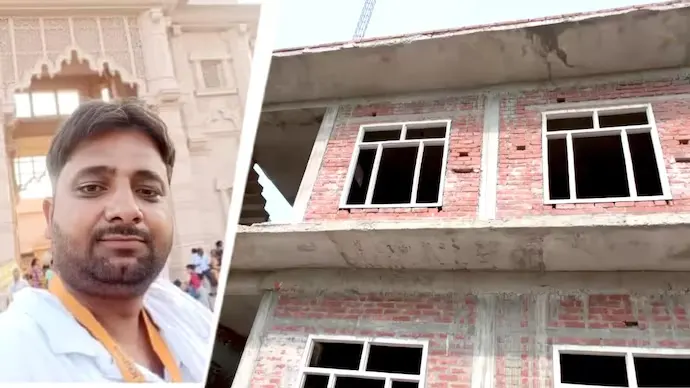
The Ayodhya Development Authority (ADA) has taken a hardline stance against the primary accused in the Ayodhya Donation Theft Case. Local enforcement teams inspected an under-construction, two-story house located near the Ayodhya-Lucknow Highway in the Sahadatganj-Banbirpur area.
Read Also: NAYARA Energy Announces Major Price Cuts for Petrol and Diesel: Check New Rates Today
The plot of land, which measures roughly 1,000 square feet, was registered under the name of Mishra's wife, Supriya Mishra.
The legal trouble for the family deepened when the ADA discovered that the construction completely bypassed local building regulations and municipal codes. The authority issued an official notice giving the family exactly one week to produce a legally sanctioned building map and layout plan.
If the family fails to submit authentic, state-approved documents within the seven-day window, the local civic administration has made it clear that demolition proceedings will begin immediately.
The property, which features a semi-finished multi-story structure with ongoing electrical work, now sits completely abandoned. Since news of the arrest spread across the district, construction workers and family members have fled the site entirely.
Who Is Luv Kush Mishra? Inside the Lifestyle of the Accused
To understand how a massive financial breach occurred within the high-security counting rooms of the temple, one must look closely at the background of those involved.
The Profile of Luv Kush Mishra
-
Age: 27 years old.
-
Role: Member of the official cash and offering-counting team.
-
Employment Source: Placed inside the counting room via a third-party outsourcing agency linked to a commercial banking institution.
-
Official Income: A modest monthly salary ranging between ₹12,000 and ₹15,000.
Before landing his job inside the temple premises, Mishra lived a highly compromised financial life in Milkipur, Ayodhya. Local neighbors and childhood acquaintances described his household as one that routinely struggled to clear basic monthly expenses. He used an old motorcycle for travel and showed no outward indicators of financial growth.
You Must Also Like: Ayodhya Ram Mandir: Indian PM Modi to lead temple construction ceremony
However, everything changed once he gained access to the daily donations, gold ornaments, and cash offerings brought in by thousands of visiting pilgrims.
Within months of working in the counting room, Mishra’s spending patterns transformed dramatically. Villagers reported that whenever he returned home on leave, he spent cash recklessly, including spending upwards of ₹50,000 on local alcohol parties for acquaintances.
The most damning piece of evidence came during a coordinated raid by the Special Investigation Team (SIT) and local magistrates.
Detectives tracking the paper trail searched Mishra's ancestral home in Milkipur and recovered over ₹12 lakh in hard cash stashed inside a heap of dried cow dung. Further land registry records exposed that the land for his highway-adjacent house was purchased for a declared value of ₹8.8 lakh, though its actual valuation has climbed past ₹25 lakh.
How the Multi-Crore Donation Scam Was Uncovered?
The financial scale of the Ayodhya Donation Theft Case is staggering. Initial findings from the SIT indicate that at least ₹7 crore in cash, gold, and expensive jewelry offerings has been systematically siphoned out of the temple complex.
The internal audit mechanism flagged deep discrepancies when comparing the expected volume of physical receipts with the final ledger bookings.
Devotees routinely drop substantial amounts of un-serialized cash into the donation boxes. This raw cash requires physical manual sorting and counting before it is securely moved to institutional bank vaults.
Mishra did not operate in isolation. He worked in tandem with his 20-year-old brother-in-law, Anukalp Mishra, who had originally secured a foothold in the counting team. Together, they formed a network with six other insiders:
-
Avinash Shukla
-
Manish Kumar Yadav
-
Karunesh Pandey
-
Ram Shankar Mishra
-
Subhash Srivastava
-
Ramashankar alias Tinnu Yadav
The local police and forensic financial teams have managed to recover roughly ₹79.85 lakh in hard cash across all eight co-conspirators so far. The breakdown of immediate cash recoveries shows the scope of the theft:
| Accused Name | Immediate Cash Recovered |
| Avinash Shukla | ₹20.39 Lakh |
| Karunesh Pandey | ₹18.07 Lakh |
| Anukalp Mishra | ₹16.82 Lakh |
| Luv Kush Mishra | ₹14.25 Lakh |
| Ramashankar Mishra | ₹7.32 Lakh |
| Ramashankar Yadav | ₹1.00 Lakh |
The legal backlash has been so severe that the Faizabad Bar Association voted unanimously to refuse legal defense services to any of the eight accused, effectively blocking local legal representation.
What Is the Final Judgment of the Ram Mandir Case?
To understand why a theft case of this nature creates such immense public anger, one must revisit the long history of the land itself. The legal conflict over the land spanned more than seven decades before arriving at a definitive solution.
The final judgment of the Ram Mandir case was delivered by a unanimous five-judge Constitution Bench of the Supreme Court of India on November 9, 2019. The bench was headed by the then Chief Justice of India, Ranjan Gogoi.
Core Points of the 2019 Supreme Court Judgment:
-
Land Ownership: The entire disputed land of 2.77 acres in Ayodhya was awarded to the deity, Ram Lalla Virajman.
-
Trust Formation: The central government was directed to set up a specialized trust within three months to oversee the construction and management of the temple. This led to the creation of the Shri Ram Janmabhoomi Teerth Kshetra Trust.
-
Alternative Land Allocation: The court ordered that an alternative plot of 5 acres of prominent land be allocated to the Sunni Central Waqf Board in Ayodhya for the construction of a mosque.
-
Archaeological Evidence: The judgment relied heavily on structural findings from the Archaeological Survey of India (ASI), which proved that a non-Islamic underlying structure existed beneath the demolished building.
This historic ruling paved the way for massive public and corporate financial backing, making the temple one of the most heavily funded religious projects in modern history.
The Philanthropy Behind the Temple: Who Gave the Highest Donation for Ram Mandir?
The money involved in the Ayodhya Donation Theft Case was collected from the savings of regular people and large donations from wealthy individuals. The temple's money comes entirely from people giving voluntarily, not from government funds.
Looking at the donations from individuals and groups, the biggest single contribution to the Ram Mandir was made by the famous spiritual leader Morari Bapu. He raised ₹11.3 crore within India. His followers in the US, Canada, and the UK also contributed an additional ₹8 crore to help build the temple.
Other major donors include:
-
Dilip Kumar V Lakhi (Diamond Merchant): Contributed 101 kilograms of pure gold bars, valued at approximately ₹68 crore, used for gold-plating the primary doors and structural elements.
-
Govindbhai Dholakia & Mukesh Patel: Jointly contributed precious items, including an intricate diamond-studded crown worth approximately ₹11 crore.
-
Corporate Leaders: Notable industrial figures like Mukesh Ambani contributed ₹2.51 crore during the core construction phase.
The fact that these massive, heartfelt donations from regular pilgrims and global icons were being diverted into the private bank accounts of local counting staff has caused immense anger among the public.
The fallout from the investigation has already forced top-tier institutional restructuring, including the high-profile resignations of the Trust's General Secretary Champat Rai and trustee Anil Mishra.
Practical Insights: Lessons for Devotees and Donors
For common citizens who regularly send monetary offerings to major religious institutions, the Ayodhya Donation Theft Case highlights the risk of using unmonitored transaction channels. Relying on physical cash boxes leaves your hard-earned funds vulnerable to manual insider manipulation.
How to Ensure Your Donations Are Secure?
-
Avoid Un-serialized Cash Drop-boxes: Physical cash dropped into open temple boxes requires manual human counting, which creates an immediate window for theft.
-
Prioritize Verified Digital Channels: Always use official UPI IDs, direct NEFT/RTGS transfers, or verified payment gateways available on the trust's verified website.
-
Insist on an Instant Digital Receipt: Authentic digital transfers provide an immutable transaction ID and generate an instant, downloadable tax-compliant receipt.
-
Utilize Section 80G Verification: Legitimate donations made via traceable bank modes qualify for standard tax deductions under Section 80G of the Income Tax Act. If a collection setup cannot provide a clear PAN-linked receipt process, do not hand over your money.
The special investigation team continues to trace secondary properties and hidden lockers belonging to Luv Kush Mishra's extended family networks. With municipal bulldozers on standby, the state is enforcing a clear message: public faith cannot be exploited for personal luxury.
For a complete look at the physical properties involved and the enforcement actions taking place on the ground, you can watch this Report on the Ayodhya Accused Property and Bulldozer Action. This video provides real-time broadcast coverage unmasking the assets tied to the investigation.