Supreme Court Issues Notice on Pellet Gun SOP: Latest News
The Supreme Court on Thursday examined a plea challenging the use of metallic pellet guns by police during the CJP protests at Delhi's Jantar Mantar.
A bench comprising Chief Justice of India Surya Kant and Justice Joymalya Bagchi observed that police rules permit such measures only "in exceptional circumstances" .
The court issued notice to the Centre and sought its response on the rules and SOP governing the deployment of pellet guns by police forces.
What Happened at Jantar Mantar?
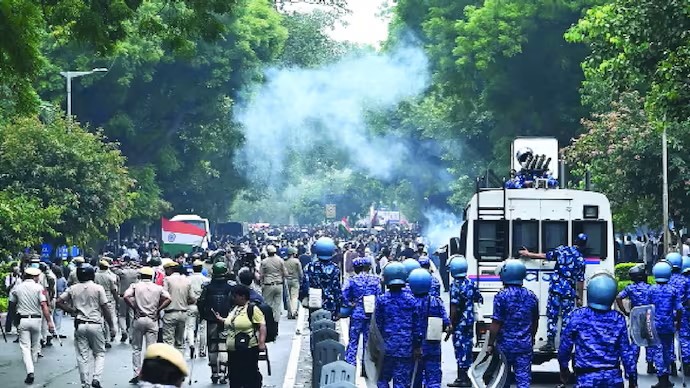
The case stems from violence during the Cockroach Janta Party's 'Chalo Sansad' march on July 20 over the NEET-UG paper leak controversy . Clashes erupted between demonstrators and security personnel at multiple locations around Jantar Mantar. Several protesters and police personnel sustained injuries during the confrontation.
Related Article: CJP Protest in Delhi LIVE: Security Tightened at Jantar Mantar as CJP Prepares Parliament March
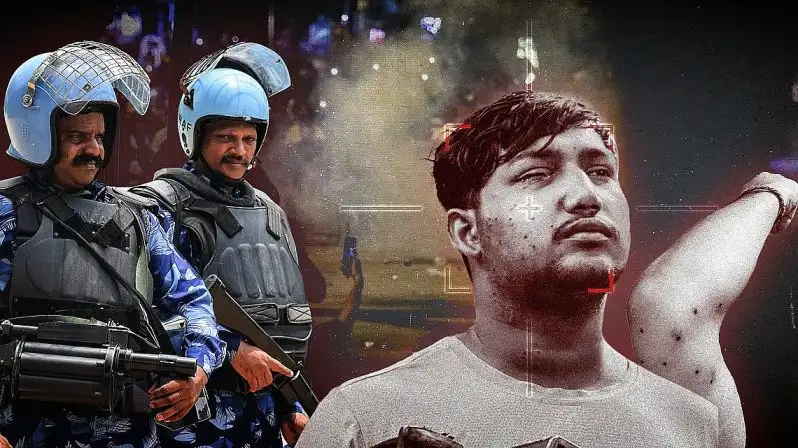
The security operation triggered political controversy after reports claimed protesters suffered grievous injuries from projectiles used during the security operation.
Official records submitted by police show the Rapid Action Force used 55 non-electrical shells, 15 electrical shells, five tear smoke grenades, two anti-riot gun rounds and two rounds of plastic pellets to disperse the crowd.
The Arguments Before the Court
Petitioners' Stand: Metallic Pellets Are Excessive Force
Senior advocate Vrinda Grover, appearing for the petitioners, argued that the weapons used against protesters fired "kinetic metallic projectiles" . She distinguished these from rubber or plastic pellets.
"There can be rubber, plastic and metallic pellets. These were metallic and recovered from the bodies. Nature of the crowd will determine use of this as well. Was it a violent mob? No. These metallic pellets were fired," Grover told the bench .
She further submitted that metallic pellets had been recovered from the bodies of injured protesters. She questioned why such force was used when the crowd was not violent .
Justice Bagchi's Observation: Graded Response Framework
Justice Joymalya Bagchi pointed out that existing police rules already contemplate the use of pellet guns in limited situations. He noted that police rules permit such measures "in exceptional circumstances.
"But police rules allow the use in exceptional circumstances unless you challenge the rules themselves. One of the steps of the graded approach is the use of pellet guns," he observed.
The court said it was willing to examine whether pellet guns were used appropriately in this case. However, the bench noted that petitioners would first have to prove that their use violated the graded use-of-force guidelines under police rules.
"We are not averse to examining the use of pellets in an individual case. You have to show us whether the graded response allows the use of pellets, especially when even bullets are permitted in some situations," Justice Bagchi said.
Why the Court Favors Protocols Over a Total Ban?
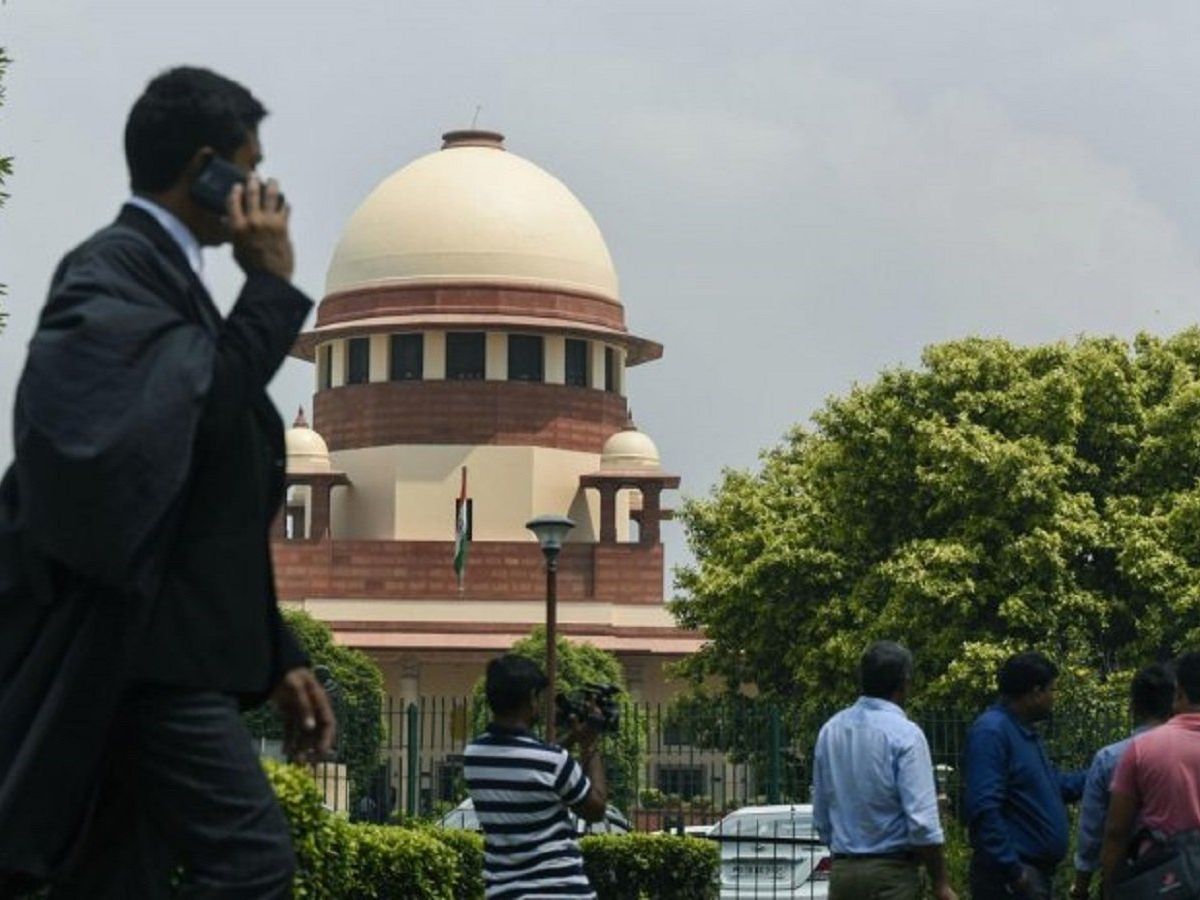
Chief Justice Surya Kant made a crucial suggestion during the hearing. Instead of seeking a complete ban on pellet guns, the petitioners could ask the court to frame clear guidelines for their use.
You Must Also Like: ITR Filing Deadline AY 2026-27: Staggered Dates Announced - Check July 31 And Aug 31 Deadlines!
"In light of the alleged excessive use, your prayer should be that the court lays down a protocol regarding the use," the CJI observed.
This approach reflects the court's practical stance. A total ban might not be feasible given the security challenges law enforcement faces. However, strict protocols and guidelines could ensure pellet guns are used only when absolutely necessary and with proper oversight.
The Graded Use of Force Principle
The court emphasized that student protests should be handled peacefully whenever possible. However, authorities may use graded levels of force in situations where it becomes necessary .
"We are in agreement with your prayer for no violence principle on persons expressing dissatisfaction or protesting. But graded response may be required in some cases," Justice Bagchi observed .
The "graded response" framework means law enforcement uses increasingly forceful measures depending on the situation. Pellet guns appear at the higher end of this spectrum, reserved for exceptional circumstances where lesser measures have failed .
The Question of Standing Orders
Grover argued that there was no known standing order of the Delhi Police authorising the use of pellet guns. "There is no standing order of Delhi police mandating the use of pellets. If that is there, let it be placed. I am sure Union or NCT does not want to fire pellets at students," she submitted .
This is a significant point. If no clear written policy exists, then the use of pellet guns may have occurred without proper legal authorization. The court has directed Delhi Police to place the existing SOP on record .
Historical Context: The Pellet Gun Debate
This is not the first time Indian courts have grappled with the pellet gun question. In 2016, the Supreme Court had said pellet guns should not be used indiscriminately and excessively in Jammu and Kashmir for controlling unruly crowds .
The court had sought assurance from the Centre and state government that pellet guns would be used only after proper application of mind by authorities concerned .
The use of pellet guns became a major debate during the clashes in Kashmir Valley following the killing of Hizbul Mujahideen militant Burhan Wani in 2016. Government data showed over 12,000 people were injured in the clashes, with 1,100 suffering serious eye injuries from pellet usage .
Government's Efforts to Find Alternatives
In July 2016, the central government constituted a seven-member expert committee to explore alternatives to pellet guns . The committee submitted its report to the Union Home Secretary in August 2016 .
In 2017, the Centre informed the Supreme Court that it would introduce new rubber-based shots to deal with stone-pelters in Kashmir Valley. The government said it had issued new SOPs, one of which involved using rubber-based shots before using pellet guns .
Attorney General Mukul Rohatgi had submitted, "We have issued a new SOP on April 7-8 that would have graded response and in the hierarchy of crowd control tools to be used, a new rubber-based shot is being introduced. This will be used before the security forces use pellet guns" .
What the Current Plea Seeks?
The petition has asked for more than just restrictions on pellet guns. It also seeks compensation and medical treatment for all those allegedly injured during police action at Jantar Mantar on July 20.
The petitioners have urged the court to ensure that victims receive proper medical care and compensation for the injuries sustained .
The petition challenges only the use of metallic pellets, not pellet guns generally. Grover clarified this distinction during the hearing. "I wish the Delhi Police or the government doesn't wish to fire metallic pellets on young people," she said .
What Happens Next?
The Supreme Court has issued notice to the Centre and the Delhi Police. It has directed the authorities to place the existing SOP governing pellet gun use on record.
This will allow the court to examine whether the deployment of pellet guns at the Jantar Mantar protest violated the existing framework. The court appears inclined to establish clear protocols rather than impose a blanket ban.
This approach balances the need for public safety with the protection of citizens' rights. Clear guidelines would ensure that pellet guns are used only in truly exceptional circumstances, with proper authorization and oversight.
The matter will now proceed for further hearing. The court has sought responses from the Centre and Delhi Police on the rules and SOP regulating pellet gun deployment .
Key Takeaways
-
The Supreme Court observed police rules permit pellet gun use only in "exceptional circumstances" .
-
The court issued notice to the Centre and sought the SOP governing pellet gun deployment .
-
Petitioners argue metallic pellets were fired at a non-violent crowd at Jantar Mantar .
-
The court suggested framing protocols over a total ban on pellet guns .
-
The bench emphasized a "no violence" principle for protests while acknowledging the need for graded force in certain situations .
-
Delhi Police has been directed to place the standing order on graded use of force on record .
-
The matter relates to CJP protests on July 20 over the NEET-UG paper leak controversy.